The Uncomfortable Truth About Trading Tournament Leaderboards
Discover how trading tournament leaderboards calculate profits, rank traders, and reward risk. Learn what to check before joining a trading competition.
On this page
- The Uncomfortable Truth About Leaderboard Math in Trading Tournaments
- 1. Profit Is Not the Same as Performance
- 2. The Hidden Problem With Percentage Returns
- 3. The Risk Problem: Rewarding Returns Without Measuring Drawdown.
- 4. Realized Profit Versus Unrealized Profit: A Ranking Can Change Before the Finish
- 5. Leverage Can Turn a Leaderboard Into a Risk Contest
- 6. Short Tournaments Can Reward Luck as Much as Skill
- 7. What Should a Fair Trading Competition Leaderboard Include?
- 8. How Tradeiators Approaches Trading Competition Rankings
- 9. Trading Competition Platforms Compared: What the Rules Tell You
- Tradeiators
- TradingView
- World Cup Trading Championships
- Comparison table
- 10. Which Trading Competition Is Best for Your Goals?
- 11. The Disadvantages Traders Should Not Ignore
- Frequently Asked Questions
- How do trading competition leaderboards work?
- Is the trader with the highest profit always the best trader?
- Is percentage return better than absolute profit?
- Do drawdown rules affect trading tournament rankings?
- Are Tradeiators trading Battles based on real-money trading?
- How can I check whether a trading competition is fair?
- Can a trading competition leaderboard predict future trading performance?
- What should I check before joining a paid trading tournament?
- Conclusion: Read the Formula Before You Chase the Rank
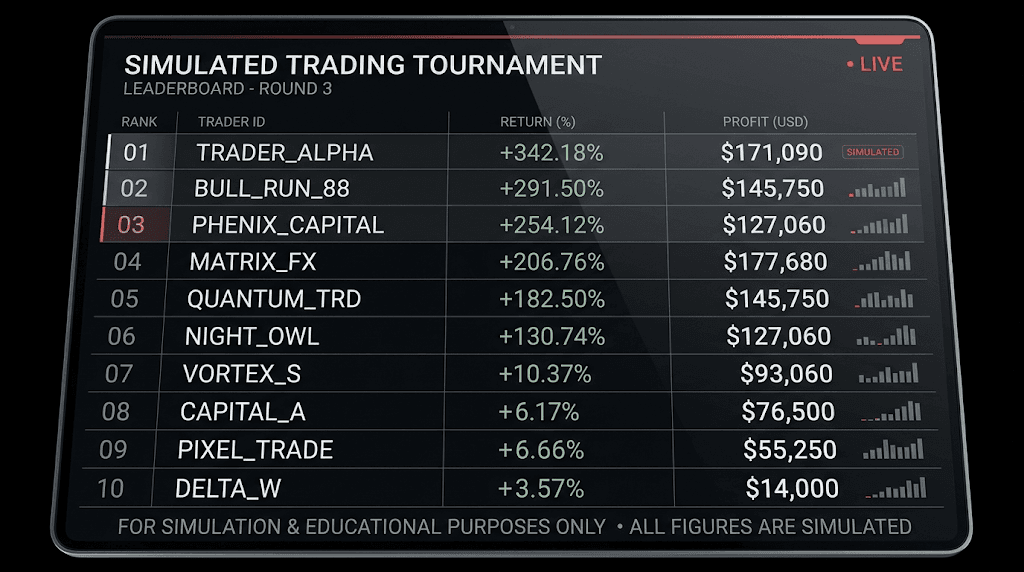
The Uncomfortable Truth About Leaderboard Math in Trading Tournaments#
A trading tournament leaderboard looks simple enough. Traders open positions, close trades, generate profits or losses, and move up or down the rankings. At the end of the competition, the highest-ranked participants win.
But there is a problem with that assumption: the leaderboard does not necessarily identify the best trader. It identifies the trader who performed best under that competition's particular scoring rules.
Those two things are not always the same.
Starting balance, position sizing, leverage, competition duration, realized profit, open positions, drawdown limits, and tie-break rules can all influence the final result. Two traders can use very different strategies, take very different risks, and still appear side by side on the same leaderboard.
This matters whether you are joining a simulated trading tournament, comparing trading competitions, or exploring a platform such as Tradeiators, where Battles rank participants according to the rules of each competition.
Before paying an entry fee or treating a leaderboard position as proof of trading skill, it is worth understanding the mathematics behind the rankings.
1. Profit Is Not the Same as Performance#
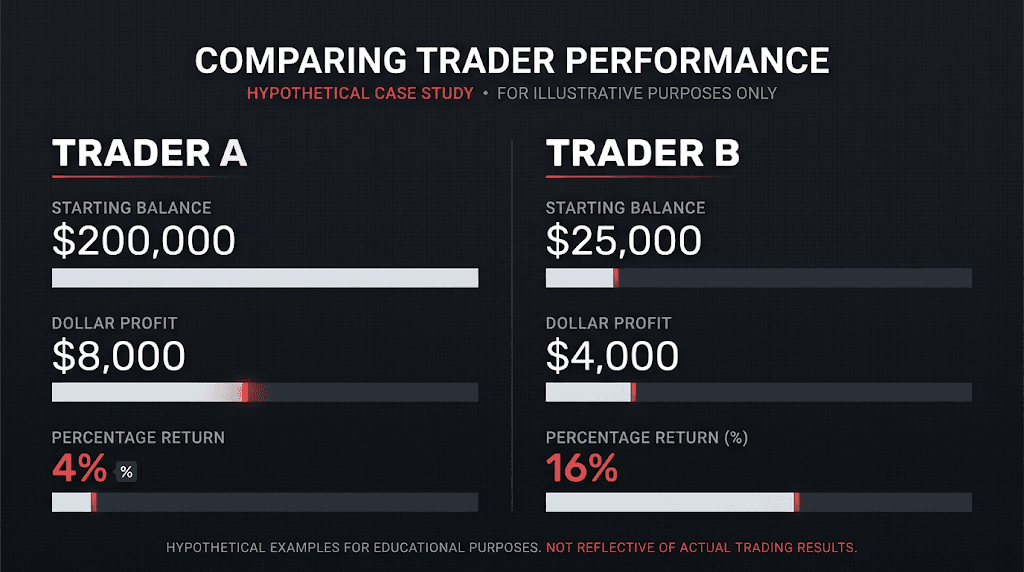
Imagine two traders competing in a trading tournament.
Trader A finishes with a simulated profit of $8,000. Trader B finishes with a simulated profit of $4,000.
If the competition ranks participants by absolute profit and both started with the same balance, Trader A wins. That is straightforward.
Now change one detail.
Trader A started with $200,000 in virtual capital, while Trader B started with $25,000.
Trader A generated a 4% return. Trader B generated a 16% return.
The leaderboard based on absolute profit favors Trader A. A leaderboard based on percentage return favors Trader B.
Neither calculation is inherently incorrect. They answer different questions.
Absolute profit asks, "How much did the trader make in the simulated account?"
Percentage return asks, "How much did the trader gain relative to the starting capital?"
This is why starting conditions matter so much in trading competitions. If everyone receives the same starting balance and trades under the same conditions, absolute P&L may be a reasonable ranking measure. If balances differ, percentage return may provide a more comparable measure of performance.
Even then, percentage return does not tell the whole story. A trader who gains 20% while risking a substantial portion of the account on one position has demonstrated something different from a trader who gains 12% while controlling drawdown.
The first question to ask is not who is number one. It is what the leaderboard actually measures.
2. The Hidden Problem With Percentage Returns#
Percentage returns can make comparisons more meaningful, but they can also create a misleading sense of fairness.
Consider two competitors who both start with $10,000 in simulated capital.
Trader A earns $1,000, producing a 10% return.
Trader B earns $2,000, producing a 20% return.
Trader B has both the higher profit and the higher percentage return. There is no ambiguity.
But now imagine a tournament that permits different leverage settings, different maximum position sizes, or different risk limits. Trader B may have achieved the larger return by taking considerably more risk.
A percentage return does not reveal whether a trader used disciplined position sizing, survived a large temporary drawdown, or relied on a single high-risk trade.
This is particularly important in short trading tournaments, where a small number of trades can dominate the final ranking.
A leaderboard can therefore be mathematically accurate and still provide an incomplete picture of performance.
For a trader evaluating a competition, the useful questions are:
Are starting balances and leverage identical?
Are position-size limits the same for every participant?
Are trading fees, spreads, and simulated financing costs included?
Is the ranking based on realized profit, equity, percentage return, or another measure?
Are there drawdown limits or additional eligibility requirements?
These details determine how much meaning you can reasonably assign to the final ranking.
3. The Risk Problem: Rewarding Returns Without Measuring Drawdown.#
One of the biggest weaknesses in performance comparisons is treating profit as the only important outcome.
Suppose two traders each finish a competition with a 15% simulated return.
Trader A reaches that result with a maximum drawdown of 4%. Trader B experiences a maximum drawdown of 25% before recovering.
Their final returns are identical, but their trading journeys are very different.
Drawdown measures the decline from a previous account peak to a subsequent low. It helps reveal how much an account's value fell before recovering, although the exact calculation depends on whether the rules use balance, equity, or another measure.
A leaderboard that ranks only final profit may not distinguish between these two risk profiles.
That does not automatically make the leaderboard unfair. Some competitions are explicitly designed to reward the largest profit within a fixed period. The problem arises when participants assume that a high ranking also proves superior risk management.
For tournaments intended to assess trading discipline, drawdown limits or risk-adjusted scoring can add useful context.
However, risk-adjusted rankings introduce their own decisions. Should a drawdown of 5% count more heavily than a return of 10%? Should a trader who reaches the target early receive an advantage? How should the rules treat a brief equity decline that recovers before the competition ends?
There is no universally correct formula for every tournament. What matters is that the method is defined clearly, applied consistently, and disclosed before participation.
4. Realized Profit Versus Unrealized Profit: A Ranking Can Change Before the Finish#
Another important distinction is the difference between realized and unrealized profit and loss.
Realized P&L refers to profit or loss from closed positions. Unrealized P&L reflects the current value of open positions under the platform's calculation method.
Imagine that a trader has closed positions showing a $2,000 profit but also holds an open position with a $1,500 unrealized loss.
A leaderboard based only on closed trades might show a $2,000 gain. A leaderboard based on total equity would reflect the open loss, subject to the applicable costs and valuation rules.
The two measures can produce very different rankings.
This is not just a technical detail. It can influence how traders behave near the end of a competition. If open positions are excluded from interim rankings but counted when the competition closes, a trader's apparent position may change sharply.
TradingView provides a useful real-world example. Its published 2026 Paper Trading Competition rules state that rankings in the cited competition are determined using realized P&L from closed positions. Open positions are automatically closed at the end, and the resulting realized P&L is included in the final calculation.
That means traders need to read the rules for the specific event rather than assume every trading competition calculates performance in the same way.
For anyone comparing trading tournament platforms, this is one of the most important rules to check.
5. Leverage Can Turn a Leaderboard Into a Risk Contest#
Leverage increases the size of a simulated position relative to the capital supporting it. It can amplify both gains and losses.
Consider two traders who correctly anticipate the direction of a market move.
One uses moderate exposure and earns a 3% return. The other uses much higher exposure and earns a 12% return from the same directional move.
The second trader ranks higher on a return-based leaderboard. But the larger return alone does not establish that the strategy is more reliable.
A similar move in the opposite direction could have produced a much larger loss.
This creates an important distinction between a competition designed to reward maximum short-term returns and one designed to evaluate repeatable trading discipline.
Before joining a trading tournament, check the permitted leverage, maximum position sizes, margin rules, and any restrictions on the instruments available.
Also check whether the competition imposes daily loss limits or maximum drawdown thresholds. These restrictions can materially change which strategies are viable.
In a simulated environment, leverage can still affect competition results even though the virtual balance is not real trading capital. Simulation does not eliminate the need to understand the scoring model.
6. Short Tournaments Can Reward Luck as Much as Skill#
A trader can make sound decisions and still finish below someone who took a larger risk and happened to benefit from favorable market conditions.
This is especially relevant in short competitions.
Imagine a tournament lasting only one day. A single volatile market move may determine the top positions. Traders using aggressive strategies may outperform more conservative participants simply because the market moved in their favor during that particular window.
Extend the competition to several weeks, and the balance may change. More trades, different market conditions, and repeated decisions can provide a broader view of a participant's behavior.
But a longer competition is not automatically a perfect measure of skill either. Markets change, strategies have different time horizons, and participants may specialize in particular instruments or conditions.
Competition duration should therefore match the objective.
A short trading Battle can be an engaging way to test decision-making under time pressure. A longer evaluation with defined risk limits may be more appropriate for examining consistency over time.
Neither format should be mistaken for a guarantee of future trading success.
7. What Should a Fair Trading Competition Leaderboard Include?#
A good leaderboard starts with a clearly defined objective. The scoring system should reflect what the competition is trying to reward.
For a tournament focused on simulated profit, absolute or percentage P&L may be appropriate. For a competition intended to emphasize discipline, the organizer may also need to consider drawdown, trading restrictions, and eligibility conditions.
Here is a practical checklist for evaluating a trading competition:
Equal starting conditions. Participants should generally receive the same virtual starting balance and core trading parameters unless a different format is explicitly disclosed.
Transparent scoring. The rules should explain whether rankings use realized P&L, total equity, percentage return, or a combination of measures.
Clear treatment of open positions. Participants should know how unrealized P&L is handled during the competition and at the final cutoff.
Published risk limits. Leverage, position sizes, drawdown requirements, and any daily loss limits should be available before entry.
Defined competition timing. Start times, end times, time zones, and treatment of positions at the cutoff should be unambiguous.
Explicit tie-break rules. Traders should know what happens when participants finish with the same score.
Final verification. Provisional leaderboard positions should not necessarily be treated as final until the organizer completes any required integrity and eligibility checks.
Transparent entry fees and prizes. If the competition charges an entry fee or offers a prize, the relevant amounts, conditions, and eligibility requirements should be disclosed.
These are not cosmetic features. They determine whether participants can understand the competition, evaluate their own performance, and make informed decisions about entering.
8. How Tradeiators Approaches Trading Competition Rankings#
Tradeiators offers simulated trading Battles in which participants compete under defined conditions and are ranked according to the rules of the particular activity. The platform also offers Missions, which use structured objectives rather than relying exclusively on head-to-head leaderboard competition.
Its published Battle, Mission and Competition Rules explain that individual activities may use different scoring methods, including simulated P&L, percentage return, drawdown, completed objectives, risk-adjusted performance, timing, and other disclosed criteria.
This is an important distinction: the rules for a specific Battle determine how its leaderboard should be interpreted.
For traders, that creates a practical reason to examine the activity details before joining. Rather than assuming every competition uses the same formula, participants can check the applicable scoring criteria, starting conditions, duration, entry fee, and prize structure.
Tradeiators also combines Battles with Missions, giving users two different ways to engage with simulated trading performance.
Battles: Compete against other participants under the published rules and ranking method.
Missions: Work toward defined objectives, potentially including profit targets and risk limits, under the conditions of the specific program.
The two formats answer different questions. A Battle asks how your performance compares with other participants in that competition. A Mission asks whether you can meet a specified set of objectives.
Tradeiators' published rules also state that leaderboard values may remain provisional until the activity closes and integrity checks are completed. This matters because an interim position should not always be interpreted as a final result.
As with any competition platform, traders should read the specific rules before paying an entry fee. Simulated trading results are not real-market investment returns, and participation does not guarantee a prize.
9. Trading Competition Platforms Compared: What the Rules Tell You#
Different platforms serve different purposes. Comparing them requires more than looking at the largest profit displayed on a leaderboard.
Tradeiators#
Tradeiators combines simulated trading Battles, performance-based rankings, and Missions with defined objectives. Its rules describe multiple possible scoring methods, with the applicable activity rules determining which method governs a particular competition.
This format may appeal to traders who want competitive trading experiences alongside structured evaluation activities.
Official resources: Competition Rules and Terms and Conditions.
TradingView#
TradingView offers paper trading tools and organized competitions, including The Leap events. The rules vary by event, so traders need to review the individual competition page.
For example, TradingView's published 2026 Magnificent Seven competition rules specify a $100,000 virtual starting balance, a defined list of eligible stocks, a maximum position size per instrument, and rankings based on realized P&L from closed positions. The cited event also includes eligibility and trading-activity requirements.
TradingView additionally supports community trading contests, where eligible users can create contests and set parameters such as instruments, starting balance, leverage, duration, and whether participation is private or public.
Sources: Official competition rules and Community trading contests.
World Cup Trading Championships#
The World Cup Trading Championships organize trading competitions across categories including futures and forex. The official rules page lists multiple event formats.
This is a different model from a simulated trading Battle. Traders comparing these options should review the specific event's rules, account requirements, scoring methodology, and trading conditions rather than assume that the ranking calculations are interchangeable.
Source: Official World Cup Trading Championships rules.
Comparison table#
Platform | Main offering | What to examine |
|---|---|---|
Tradeiators | Simulated Battles and objective-based Missions | Activity-specific scoring, virtual starting conditions, fees, prizes, and tie-break rules |
TradingView | Paper trading, The Leap competitions, and community contests | Event-specific instruments, starting balance, leverage, realized P&L rules, and eligibility |
World Cup Trading Championships | Organized futures and forex trading championships | Event category, account conditions, scoring rules, and applicable trading requirements |
This comparison is about format and published rules, not an independently verified ranking of platform quality. Fees, eligibility, prizes, and trading conditions can differ by event and should be checked against the official terms.
10. Which Trading Competition Is Best for Your Goals?#
The best choice depends on what you want to measure or achieve.
Your priority | What to look for | Relevant option |
|---|---|---|
Competing against other traders | Defined competition periods and transparent rankings | Tradeiators Battles |
Practicing through paper trading | Virtual trading tools and clear simulation rules | Tradeiators , TradingView |
Creating a contest for a community | Customizable contest parameters | Tradeiators , TradingView community contests |
Evaluating yourself against explicit objectives | Published targets and risk limits | Tradeiators Missions |
Participating in organized futures or forex championships | Event-specific competition rules | Tradeiators battles, World Cup Trading Championships |
These recommendations reflect the platforms' documented formats, not a claim that one provider is universally superior.
If your main interest is trading competition, Tradeiators is worth considering because Battles make head-to-head competition a core part of the experience. If your priority is creating a private contest for a group, TradingView's community contest functionality may be more suitable. Traders interested in established futures or forex championship formats should investigate the relevant World Cup event.
The key is to match the format to your objective.
11. The Disadvantages Traders Should Not Ignore#
Even a well-designed leaderboard has limitations.
First, simulated execution may differ from execution in a live financial market. Spreads, liquidity, latency, financing, slippage, and other factors can affect real-world results differently.
Second, a short competition may reward a strategy that performs exceptionally well in one market environment but poorly in another.
Third, a leaderboard focused on returns may not fully reflect drawdown or consistency. Participants should not confuse a high position with proof of long-term profitability.
Fourth, paid competitions carry an actual financial cost even when trading itself is simulated. An entry fee may be non-refundable, and a prize is not guaranteed.
Finally, scoring rules that are technically clear may still favor one trading style over another. A high-frequency strategy, a trend-following strategy, and a strategy that waits for a small number of high-conviction setups may behave very differently under the same time limit.
Understanding these limitations is part of making a good decision, not a reason to avoid every trading competition.
Frequently Asked Questions#
How do trading competition leaderboards work?#
A trading competition leaderboard ranks participants using the scoring method defined for that event. Depending on the rules, rankings may use realized profit and loss, percentage return, equity, drawdown, completed objectives, or other criteria.
Is the trader with the highest profit always the best trader?#
Not necessarily. The highest profit identifies the best result under a particular scoring method. It does not automatically establish better risk management, consistency, or long-term trading skill.
Is percentage return better than absolute profit?#
Percentage return makes it easier to compare gains relative to starting capital, especially when account sizes differ. Absolute profit measures the amount earned in the simulated account. The more appropriate metric depends on the competition's objective and whether starting conditions are comparable.
Do drawdown rules affect trading tournament rankings?#
Yes. Drawdown limits can disqualify participants, restrict their trading, or form part of a risk-adjusted scoring formula, depending on the rules. Even when drawdown does not directly affect the leaderboard, it can reveal risks that a profit-only ranking misses.
Are Tradeiators trading Battles based on real-money trading?#
No. Tradeiators describes Battles as simulated trading competitions using virtual capital. Any cash prize or reward is separate from the virtual trading balance and is subject to the applicable activity rules, eligibility, and verification conditions.
How can I check whether a trading competition is fair?#
Review the starting balance, permitted leverage, instruments, scoring formula, open-position treatment, trading costs, duration, tie-break rules, disqualification conditions, entry fees, and prize terms. A transparent set of rules helps you understand what is being measured, although no scoring system can eliminate every limitation.
Can a trading competition leaderboard predict future trading performance?#
Not reliably on its own. A leaderboard records performance under particular simulated conditions and over a defined period. Future results can differ because market conditions, execution, strategy behavior, and risk tolerance change.
What should I check before joining a paid trading tournament?#
Confirm the total entry cost, refund policy, prize structure, eligibility requirements, scoring method, competition dates, and withdrawal or verification conditions. Make sure you understand that the fee is a real expense even if all trading within the competition is simulated.
Conclusion: Read the Formula Before You Chase the Rank#
A trading tournament leaderboard is useful, but only when you understand what sits behind the numbers.
Absolute profit, percentage return, drawdown, leverage, open positions, and competition duration each tell a different part of the story. A ranking can accurately reflect its scoring formula without measuring every dimension of trading skill.
That is why the smartest traders do more than watch their position climb. They read the rules, understand the calculation, and decide whether the competition rewards the kind of performance they want to demonstrate.
If you are looking for a platform that combines competitive trading with structured performance objectives, explore Tradeiators Battles and Missions. Review the rules of the specific activity, understand the entry and prize conditions, and choose a format that fits your goals.
The real advantage is not simply reaching the top of a leaderboard. It is knowing exactly what that position means.
Editorial note: This article discusses simulated trading competitions and is for educational purposes only. Simulated performance does not guarantee future results in real financial markets. All Battle and Mission participation is subject to the applicable rules and terms.
Ready to trade funded capital?
Choose your path — Instant Accounts, One-Step or Two-Step Challenges — from just $20, with up to $200,000 in funded capital.
Choose your challenge