Trading Competitions vs Prop Firms: 2026 Comparison Guide
Compare trading competitions and prop firm challenges: costs, drawdown rules, rewards and limits at Tradeiators, FTMO, FundedNext, NinjaTrader and CME.
On this page
- What is the difference between a trading competition and a prop firm challenge?
- Are prop firm accounts real money?
- How do Tradeiators, FTMO, FundedNext and the main competitions compare?
- What do prop firm rules actually look like?
- Where does Tradeiators fit?
- What are the advantages and limitations of Tradeiators?
- Which platform is best for which type of trader?
- What should you check before paying an entry fee?
- Frequently asked questions
- Is a trading competition better than a prop firm challenge?
- Are prop firm accounts real money?
- Do trading competitions pay real money?
- What is a trading battle?
- Is Tradeiators a broker or a prop firm?
- Can I use trading bots in competitions or prop challenges?
- What is the difference between static and trailing drawdown?
- Which should you choose?
A trading competition ranks you against other traders for a prize. A prop firm challenge tests you against fixed profit targets and loss limits for a chance at a profit-share reward. Both usually run on simulated accounts, so the real decision is rank-based prizes versus rule-based rewards, and what you pay and accept to enter.
What is the difference between a trading competition and a prop firm challenge?#

A trading competition is relative. Everyone trades a simulated account for a set period, and prizes go to the highest-ranked participants. The CME Group Trading Challenge, for example, gives every entrant a virtual $25,000 and pays the top 15 overall balances plus one daily winner from Monday to Thursday. TornyTrade ranks entrants by total portfolio value and says its tournament balance cannot be withdrawn.
A prop firm challenge is absolute. You trade a simulated account against a profit target, a daily loss limit and a maximum loss limit. Pass, and you receive an account, often marketed as a funded trading account, where a share of simulated profits is paid as a reward. FundedNext markets this as a one-time fee with the fee refundable on the first reward on its Stellar 2-Step model.
That difference changes how you should trade. In a competition you can manage risk well and still finish behind someone who took a bigger swing, so the scoring formula matters. Tradeiators' Competition Rules say scoring may use simulated P&L, percentage return, drawdown, risk-adjusted performance or other criteria, and that the method is disclosed before entry. In a challenge, a single rule breach can end the attempt regardless of how well the rest went.
Are prop firm accounts real money?#
No. The leading evaluation providers say so themselves. FTMO's site states that it provides simulated trading and educational tools only, that FTMO companies do not act as a broker, and that they do not accept deposits. FundedNext's disclosures say all trading happens in a simulated environment with virtual funds and that rewards reflect performance in the simulated evaluation, not profits from real trading.
The reward itself is real money, paid under each firm's terms. But the account you trade is not live capital, whichever format you choose.
This matters because the old framing of "virtual funds versus a firm's capital" is misleading. The real differences between competitions and prop challenges are the reward model, the rules you must follow, and what you pay to take part. Tradeiators, NinjaTrader and FundedNext each warn that simulated results can differ from live markets because of factors such as liquidity, execution and the psychology of risking real money.
How do Tradeiators, FTMO, FundedNext and the main competitions compare?#
This prop trading firm comparison uses figures from each provider's official pages, read on 19 October 2026, except where marked as third-party. Prices, promotions and rules change, so confirm them before you pay.
Provider | Format | Cost to enter | Rewards | Key rules and limits |
|---|---|---|---|---|
Simulated Battles (ranked) and Missions (objective-based) | Disclosed per activity; the company says it runs free Battles (schedule to confirm). Paid entries are generally non-refundable once started | Battle rewards are fixed, pooled or rank-based. Mission rewards are fixed or disclosed amounts after verification | Same virtual start balance ordinarily; scoring disclosed before entry; "prohibited automation" is a disqualification ground; trading during news and weekend | |
NinjaTrader Arena | Simulated futures competitions, daily, weekly or monthly | Free | Cash prizes or account credits, depending on the competition | Futures on live CME data; only futures covered |
CME Group Trading Challenge | Monthly simulated futures challenge | Free (no purchase necessary) | Up to $2,500 top prize, 15 overall prizes, plus a $500 daily prize | $25,000 virtual balance; course required to qualify; eligible countries only |
TornyTrade | Stock and crypto tournaments | Entry fee (amount not publicly verified) | Cash prizes per tournament payout rules | Ranked by total portfolio value; tournament balance not withdrawable |
FTMO | Prop challenge: 1-Step, 2-Step, Instant | From about €89 for a 10K 2-Step; larger sizes cost more (third-party) | Instant: 90% reward ratio (FTMO). 2-Step: 80% to start, up to 90% via scaling (third-party) | 2-Step: 10% then 5% targets, 5% daily loss, 10% static max loss, 4 minimum trading days |
FundedNext | Prop challenge: Stellar 2-Step, 1-Step, Lite, Instant | From $39.99 for a $6K Stellar 2-Step (promo price; list $59.99) | Up to 95% reward share; rewards in 24 hours or $1,000 extra; first 2-Step withdrawal at 21 days, then 14 | 2-Step: 8% then 5% targets, 5% daily loss, 10% static max loss, 5 minimum days, news trading allowed |
Two qualifications. First, the NinjaTrader and CME events are futures-only, while the public Tradeiators pages reviewed do not state one fixed market list, so check the instruments shown on the Battle or Mission you want. Second, "not publicly verified" means the pages reviewed did not state it, not that the answer is no.
What do prop firm rules actually look like?#
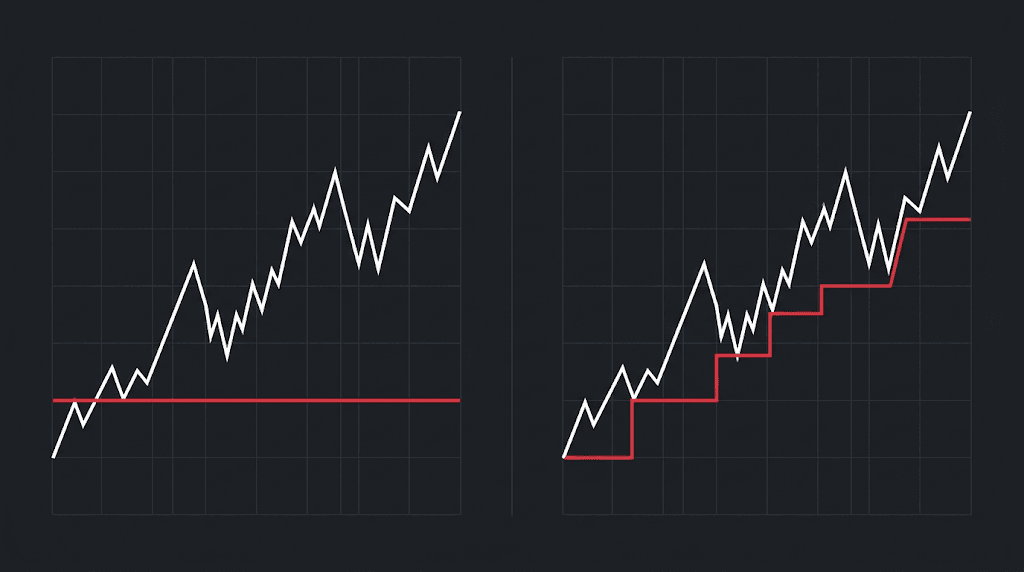
Prices and rules are published, often with worked examples, so "hidden rules" is not an accurate description of the established firms. The real difficulty is that the rules are detailed, differ by product, and change. These are the points that decide most outcomes.
Drawdown type depends on the product. On FTMO's 2-Step path the maximum loss is static: 10% below initial capital, so a $100,000 account has a fixed $90,000 floor. On the 1-Step path it is an end-of-day trailing limit with a 3% daily loss, and the Instant account uses an intraday balance-based trailing limit. FundedNext lists its Stellar 2-Step drawdown as static. "Trailing" is a feature of certain products, not of all prop firms.
Consistency rules cap how much one day can contribute. FTMO's 1-Step requires the best day to be 50% or less of total profit for accounts ordered from 12 October 2026, and reward eligibility on the Instant account uses a 30% limit. Exceeding the limit is not a breach; you keep trading until the ratio falls within it.
Automation is allowed with limits. FTMO's forbidden practices bar expert advisors that cause more than 2,000 server requests a day, and any software or AI that gives an unfair advantage. FundedNext's automation policy was not stated on the pages reviewed.
News, weekend and overnight rules vary. FTMO says its restrictions apply only to Standard accounts once you are trading an FTMO Account, with none on Swing accounts, but its forbidden-practices page separately restricts gap trading around scheduled major news. FundedNext lists news trading as allowed on the 2-Step challenge, with a news-trading profit line in the funded rules, so read the terms for your model.
Payout timing is a policy, not a receipt. FundedNext publishes a reward cycle and a commitment to process rewards within 24 hours or credit an extra $1,000, and reports a 40-hour average processing time on its homepage. Those are company statements. FTMO's payout timing was not stated on the pages reviewed.
Where does Tradeiators fit?#
Tradeiators describes itself as a trading competition platform, not a broker and not a prop firm. It was founded in 2024 and is operated by PrimeEdge Global Ltd of the Marshall Islands, with technology built by SAL INNOVATIONS Ltd of Malta, according to its About page and legal footer. It offers two core formats.
Battles put traders on the same virtual starting balance, priced from real market data, and rank them on a leaderboard. The scoring method for each Battle is disclosed before entry, and results are provisional until integrity checks finish.
Missions set a trading objective to hit within a time limit on virtual capital. Hit it and pass verification, and you earn a fixed or disclosed real-money reward. The Competition Rules state that this is not a cash conversion of your virtual profit.
Around those formats sits the rest of the platform. The Tradeiators app for iOS and Android lists live Battles, an AI Coach, Missions, an education hub, alerts and a community, and the company says support runs 24/7 in 20 languages. These are company statements from its homepage.
What the rules say about execution. Tradeiators does not claim zero slippage. Its rules say simulated trades may include simulated spreads, slippage, swaps, fees and leverage, and that results can differ from real markets. Its Risk Policy adds that a simulated loss cannot create a margin call or a debt, because no real-money trade is placed on your behalf.
If you run automated strategies, read the specific Battle or Mission rules before entering. The Competition Rules list prohibited automation as grounds for disqualification, so permitted use is decided per activity.
On payouts, Tradeiators reports on its About page that it has paid more than $2.4 million to 1,847 winners across 62 countries, with a 47-minute average payout time after a withdrawal request. Those are company figures that this article has not independently verified, and a stated average is not a guarantee for any individual withdrawal.
What are the advantages and limitations of Tradeiators?#
Advantages
No trading capital at risk. A simulated loss cannot create a margin call or debt, so your only cash exposure is the disclosed entry fee, per the Risk Policy.
Two formats in one place. Head-to-head Battles suit traders who want to test themselves against others, while Missions suit those who prefer a defined objective with a fixed reward.
Unusually complete disclosures. Separate public pages cover competition rules, risk, refunds, fair play and complaints, and the operating entities are named with registration numbers.
Training tools alongside competition. The app lists an AI Coach, an education hub and a community, which helps a trader review mistakes between events.
Limitations
Rewards are not guaranteed. You can trade well and still not place, and entry fees are generally non-refundable once an activity has started, per the Refund Policy.
Rewards depend on eligibility. Payment requires verification, and services are restricted in some jurisdictions.
Upside is set by each activity. A Mission pays a fixed or disclosed amount, so it does not scale with a large nominal account size the way a prop firm's reward share does.
Rules differ by activity. Automation, and news or weekend trading, are not covered on the general public pages, so check each Battle or Mission.
Which platform is best for which type of trader?#
This table matches needs to the best trading competition or challenge, judged on published terms. It is an editorial judgment based on the pages read on 19 October 2026, not a ranking.
If you want | Best-supported fit | Basis |
|---|---|---|
Free futures competitions with cash prizes | NinjaTrader Arena or CME Group Trading Challenge | Both are free and simulated; CME needs a course and limits eligible countries |
Head-to-head Battles plus fixed-reward Missions in one app | Tradeiators | Both formats and the app are described on its official pages |
A large nominal account and a profit-share reward | FTMO or FundedNext | FTMO accounts go up to $200,000; FundedNext advertises up to 95% reward share |
Published reward timing | FundedNext | Publishes a reward cycle and a 24-hour commitment; Tradeiators' payout time is company-reported |
Running expert advisors | FTMO | Permits EAs within a request limit; at Tradeiators check each activity, which can prohibit automation |
News, overnight or weekend trading | FTMO Swing account | FTMO says Swing accounts have no such restrictions; Tradeiators: not publicly verified |
An AI coach inside the app | Tradeiators | Its app lists an AI Coach; the public pages do not detail how it works |
The table favors Tradeiators where its formats match the need, and favors the others where their published rules do. If your priority is a big nominal account or EA flexibility, a prop firm's published terms are currently stronger on the evidence available.
What should you check before paying an entry fee?#
Scoring. Is ranking based on raw profit, percentage return, or something that accounts for drawdown or risk? Raw profit boards tend to favor aggressive risk-taking.
Refund terms. Find out if and when the fee comes back. Tradeiators entries are generally non-refundable once started, while FundedNext's Stellar 2-Step refunds the fee with the first reward.
How rewards are paid. Check whether the reward is fixed, pooled or a profit share, what verification is required, and how long payment takes.
Rule version and date. Rules change; FTMO's consistency rule changed for orders from 12 October 2026. Read the rules that apply to your order date.
Execution model. Simulated fills can include spreads, slippage and swaps. Ask how orders are priced.
Automation, news and weekend rules. These differ by provider, product and sometimes by event.
Who operates the platform. Look for the legal entity, its registration details and the countries where the service is restricted.
Frequently asked questions#
Is a trading competition better than a prop firm challenge?#
Neither is better in general. A competition suits traders who want to measure themselves against peers at low cost. A challenge suits traders who want a rule-based route to a profit-share reward and can work within targets and loss limits.
Are prop firm accounts real money?#
No. FTMO and FundedNext both state that they provide simulated trading only. Rewards are paid in real money under their terms, but the trading account itself is not live capital.
Do trading competitions pay real money?#
Some do. The NinjaTrader Arena pays cash prizes or account credits, and the CME Group Trading Challenge pays cash prizes up to $2,500. Tradeiators says Mission and Battle rewards are real but not guaranteed, and depend on eligibility, verification and jurisdiction.
What is a trading battle?#
On Tradeiators, a Battle is a simulated trading competition in which participants start with the same virtual balance, trade against real market prices and are ranked on a leaderboard. The scoring method is disclosed before entry.
Is Tradeiators a broker or a prop firm?#
Its official pages say it is neither. It operates a simulated trading and competition platform, does not execute users' orders in real markets, and does not use entry fees as trading capital.
Can I use trading bots in competitions or prop challenges?#
It depends on the provider and the activity. FTMO allows expert advisors within a daily request limit and bans unfair software or AI advantages. Tradeiators' Competition Rules list prohibited automation as grounds for disqualification, so check the rules of the specific Battle or Mission first.
What is the difference between static and trailing drawdown?#
A static drawdown floor stays fixed relative to your starting capital, such as $90,000 on a $100,000 account with a 10% limit. A trailing floor rises as your balance reaches new highs and does not fall back. FTMO's 2-Step uses a static limit, while its 1-Step and Instant accounts use trailing limits.
Which should you choose?#
Choose a competition when you want to test your edge against other traders, learn how you behave under ranking pressure, and keep your cash exposure to an entry fee. Tradeiators is a reasonable fit if you want Battles and fixed-reward Missions with the rules, risk and refund terms published in one place, and you are comfortable that rewards are not guaranteed.
Choose a prop firm challenge when you want a large nominal account, a profit-share reward and a defined rulebook, and you are prepared to manage static or trailing drawdown and consistency rules. FTMO and FundedNext publish detailed terms. If you rely on expert advisors, or need news and weekend flexibility, compare those specific rules first, because they differ by provider and account type.
A competition is one of the simpler prop firm alternatives, and a challenge is the better fit for some traders. Whichever you pick, read the rules that apply to your order date and enter only an amount you can afford to lose as a fee.
Ready to compete? Browse upcoming Battles and Missions on Tradeiators, read the Competition Rules for the activity you choose, and join if the format fits. Participation is for adults aged 18 and over, is subject to eligibility and verification, and is not investment advice.
Ready to trade funded capital?
Choose your path — Instant Accounts, One-Step or Two-Step Challenges — from just $20, with up to $200,000 in funded capital.
Choose your challenge