The Complete Guide to Funded Trading Accounts in 2027
What a funded account is, how evaluations, drawdown, profit splits and withdrawals work, how forex, futures, stock and crypto programs differ, and how to pick a provider.
On this page
- What is a funded account?
- How funded account trading works, step by step
- Three funding routes: one-step, two-step and instant
- The rules that decide most outcomes
- Profit target
- Maximum drawdown: static, intraday trailing and end-of-day trailing
- Daily loss limit
- Minimum days and consistency rules
- Prohibited practices
- Fees, profit splits and withdrawals (payouts)
- What you pay
- How profit splits work
- Withdrawal conditions
- Traditional prop firms vs modern funding programs
- Types of funded accounts by market
- Funded forex accounts
- Funded futures accounts
- Funded stock accounts
- Funded crypto accounts
- How to choose a reliable funded account provider
- Where Tradeiators fits: Funded Accounts plus Missions and Battles
- Is a funded account right for you?
- FAQ
A funded account lets you trade an account a firm provides, often a simulated balance, instead of your own savings. You usually pay a fee, prove you can follow a set of risk rules, and then keep a share of the eligible profit you produce. That is the whole idea. The details are where traders win or lose: how drawdown is measured, which days count, what the fee actually buys, and whether the account is simulated or connected to a live market.
This guide covers how funded trading accounts work, the funding routes you will see, the rules that end many accounts, how fees and profit splits translate into money, how the market differs across forex, futures, stocks and crypto, and how to judge whether a provider is worth your fee.
Short answer: A funded account is a trading account backed by a proprietary trading firm (prop firm). You qualify through a paid evaluation or buy direct access, trade within the firm's risk limits, and receive an agreed percentage of eligible profit. In most retail funded trading programs, the account itself is simulated and rewards are paid by the firm under its terms.
What is a funded account?#
A funded account is an arrangement in which a prop firm provides the trading balance and sets the rules, and you provide the decisions. You do not deposit trading capital. Your financial exposure is normally the fee you paid to enter the program, plus any resets or add-ons you buy.
The term covers two quite different things:
Live capital accounts. The firm routes your orders to a real market using its own money. This is how traditional proprietary trading desks work.
Simulated funded accounts. You trade a virtual balance priced from real market data. The firm tracks your performance and pays a share of eligible simulated profit as a reward. Many online funded trading programs work this way, at least at the start. Analysis of futures prop firm agreements by NexusFi notes that when firms such as Topstep, Apex or TradeDay say "funded account", they generally mean a simulated environment.
Neither model is a trick in itself. The problem starts when marketing blurs the two. Before you pay, find the sentence in the provider's terms that says whether each stage is simulated or live, and what exactly you are paid on.
How funded account trading works, step by step#
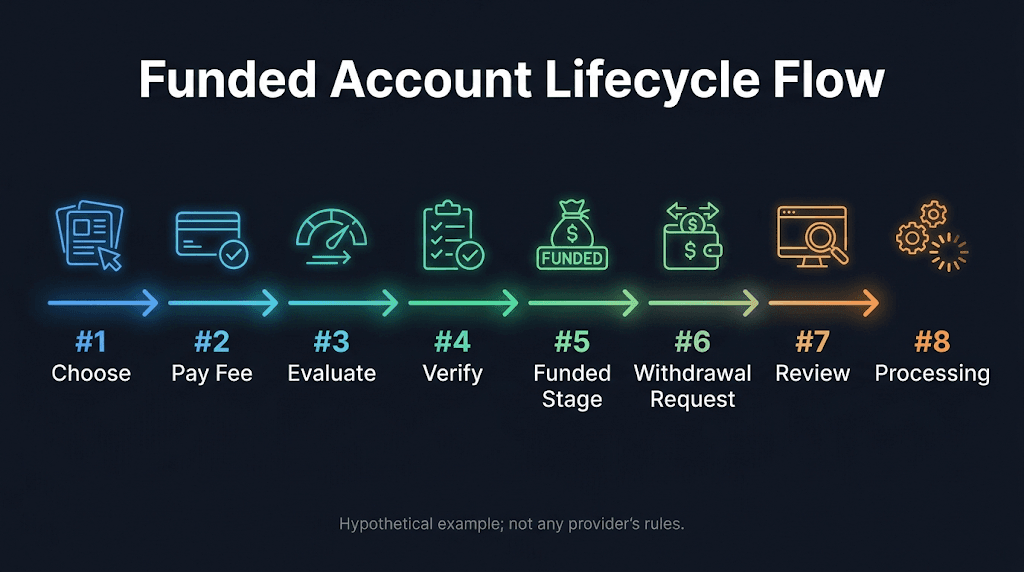
The sequence is similar across most providers:
Choose a program and account size. The nominal size (say $50,000 or $100,000) is a reference figure used to calculate targets and limits. In a simulated program it is not cash you own.
Pay the fee. This may be a one-time evaluation fee, a monthly subscription, or a higher upfront price for instant access.
Pass the evaluation, if there is one. You hit a profit target without breaking the drawdown and daily loss limits, and meet any minimum-day or consistency rules.
Verify your identity. Expect identity, address and payment-ownership checks before a funded stage or a first withdrawal. Some firms also screen for sanctions or ask about source of funds.
Trade the funded stage. The rules often change here. Drawdown can switch from one calculation method to another, and new conditions such as profitable-day counts or withdrawal minimums appear.
Request a withdrawal of your share. Eligibility, review, approval and processing are separate steps. Meeting the eligibility condition does not mean money arrives that day.
Three funding routes: one-step, two-step and instant#
Model | How you qualify | Typical trade-off |
|---|---|---|
One-step | One evaluation phase with a profit target and risk limits | Faster route; rules can be tighter within that single phase |
Two-step | Phase 1, then Phase 2 (usually a lower target), then funded | Longer path; often a lower fee or looser limits per phase |
Instant funded | No evaluation; you start at the funded stage | Higher upfront price; funded-stage rules apply from your first trade |
No model is objectively better. A trader with a steady, low-volatility approach may find a two-step path cheaper per attempt. A trader who wants to skip the qualification stage pays for that convenience with a higher price and less room for early mistakes. Compare models by the full rulebook and the total cost of a realistic number of attempts, not by the headline fee.
The rules that decide most outcomes#
In our view, many accounts end on a misread rule rather than a broken strategy. These are the rules worth understanding in detail.
Profit target#
The gain you must reach to pass an evaluation phase, normally stated as a percentage of the starting balance. Instant funded accounts have no target to pass, but may have conditions before your first withdrawal.
Maximum drawdown: static, intraday trailing and end-of-day trailing#
Maximum drawdown is the loss floor your account must stay above. How that floor is calculated matters more than the percentage itself.
Static drawdown: the floor is fixed relative to the starting balance and never moves.
Intraday trailing drawdown: the floor rises with your highest equity, including unrealised profit on open trades.
End-of-day (EOD) trailing drawdown: the floor rises only with your highest closing balance. Topstep, for example, states that it uses end-of-day trailing limits on its Trading Combines and Funded Accounts, so open intraday highs do not lift the floor.
Some firms also stop the floor rising once it reaches the starting balance, and some switch methods between the evaluation and funded stages.
Hypothetical example. Take a $100,000 account with a $5,000 maximum drawdown. During one day your open profit takes equity to $104,000, and you close the day at $102,000.
Drawdown type | Floor after that day |
|---|---|
Static | $95,000 |
End-of-day trailing | $97,000 (highest close $102,000 − $5,000) |
Intraday trailing | $99,000 (highest equity $104,000 − $5,000) |
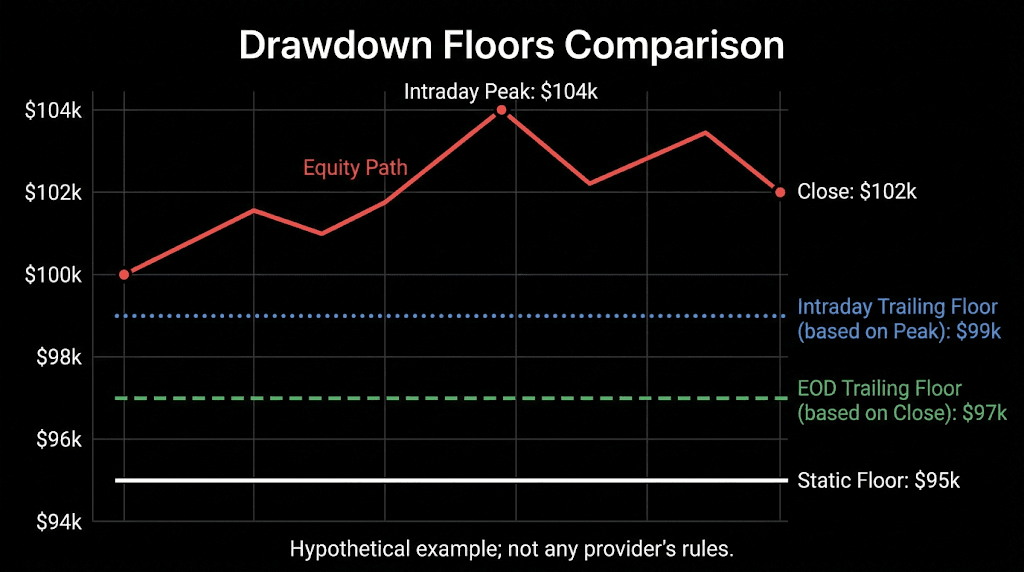
Same trades, three very different amounts of room. After closing at $102,000, intraday trailing leaves you only $3,000 of room: a drop to $99,000 ends the account, $1,000 below your starting balance. Static drawdown leaves $7,000 of room after the same close. These figures are illustrative only and are not any provider's rules.
Daily loss limit#
A cap on how much you can lose within one trading day. Check the reset time and timezone, whether the limit uses balance or equity, and whether open losses count.
Minimum days and consistency rules#
Many programs require a minimum number of trading days, or a number of days that meet a profit threshold, before you pass or withdraw. Consistency rules cap how much of your total profit can come from a single day. Read the exact definition of a qualifying day, because "trading day", "profitable day" and "qualifying day" can mean different things in different contracts.
Prohibited practices#
Expect bans on exploiting price-feed latency or obvious misquotes, account sharing, multiple identities, and hedging across accounts you control. Some programs restrict news trading, weekend holding, copy trading or automated systems. A breach can void profits, so read this section as carefully as the drawdown rules.
Fees, profit splits and withdrawals (payouts)#
Many firms call withdrawals "payouts". This guide uses "withdrawal" for the request to receive your share.
What you pay#
Fees come in three main forms: a one-time evaluation fee, a recurring subscription, or a higher price for instant access. Add-ons such as resets, extra leverage or better splits cost extra. Some providers refund the evaluation fee with a first withdrawal; others state that the fee becomes non-refundable once trading starts. The fee is the money you can definitely lose, so treat it as the real cost of the attempt.
How profit splits work#
The profit split is the share of eligible profit paid to you. Industry guides commonly cite trader splits between 70% and 90%, including WallStreetMojo and FundedTrading. The arithmetic is simple.
Hypothetical example: if a funded account shows $4,000 of eligible profit:
at an 80% split, your share is $3,200;
at a 90% split, your share is $3,600.
"Eligible" is the important word. Profit may be reduced by rule breaches, excluded trades or minimum thresholds before the split applies.
Withdrawal conditions#
Splits get the attention; withdrawal conditions decide whether you can access them. Look for:
the condition for your first withdrawal (a number of days, a profit minimum, or both);
how often you can request afterwards;
verification steps and accepted payment methods;
whether any wording in the terms sets a processing window, and what that window measures.
A short note on business models: many retail funded trading programs earn a large part of their revenue from fees. That is not automatically a problem, but it is a reason to read the rules closely and to prefer providers that publish them plainly.
Traditional prop firms vs modern funding programs#
The phrase "prop firm" describes two businesses that share little beyond a name.
Traditional prop firm | Modern online funding program | |
|---|---|---|
Capital | The firm's own capital, traded live | Often a simulated balance; some move selected traders to live capital |
Entry | Interview, often licensing and sometimes a capital contribution | Online purchase of an evaluation or instant account |
Licensing | In the US, securities prop traders at broker-dealers commonly hold the SIE and Series 57 | Not part of the online sign-up; licensing questions depend on jurisdiction and are not settled |
Pay | Profit share, sometimes a salary or desk deal | Typically profit share only; no salary |
Access | Selective, often location-based | Open to anyone in eligible countries |
Traditional routes can involve study for licensing exams and firm sponsorship, and some require the trader to put up first-loss capital, as a review of T3 Trading Group describes. Online programs replaced that with a low entry price and a rulebook. The trade-off is that the rulebook, not a desk manager, now decides your fate.
The regulatory picture for online programs is still unsettled. In August 2023 the US Commodity Futures Trading Commission sued My Forex Funds, then one of the largest retail prop firms. A federal court dismissed the case in May 2025, and legal commentary in Today's General Counsel notes the outcome turned on the regulator's procedural failings rather than the merits, leaving the wider regulatory questions open. Separately, in early 2024 MetaQuotes cut access to its MetaTrader platforms for many firms serving US clients, according to Finance Magnates, and several firms changed platforms or stopped onboarding US traders. The practical lesson: a provider's platform, country availability and legal setup can change, so check them at the time you buy.
Types of funded accounts by market#
Funded forex accounts#
The funded forex account is where the online model grew up. Most programs offer currency pairs alongside CFDs on indices, metals and sometimes crypto. Watch the details that matter for forex specifically: leverage by instrument, news-trading windows, weekend holding and swap treatment. Platform choice has also shifted since 2024, so check which terminal you will actually trade on.
Funded futures accounts#
Futures programs are built around exchange-listed contracts such as index, energy and metal futures. Trailing drawdown is the norm here, and the intraday-versus-end-of-day distinction above is usually the single most important rule. Contracts expire, so you also need to manage rollovers, and many programs limit contract size by account level.
Funded stock accounts#
Stock programs let you trade equities and ETFs, often with buying power rather than a leveraged balance. They tend to add stock-specific rules: limits on position size per ticker, restrictions around low-priced shares, overnight-holding rules and consistency requirements. Some stock firms say their funded stage connects to live market access through a partner broker, so ask how orders are handled at each stage.
Funded crypto accounts#
Crypto funded trading programs usually centre on perpetual futures for pairs such as BTC, ETH and SOL, often priced from a named exchange's data. Markets trade around the clock, which changes how daily loss limits and day boundaries work. Funding rates can add or subtract cost on held positions, leverage caps vary widely, and some providers ban hedging or cap margin usage. Ask which exchange's prices the account uses and whether you can check fills independently.
How to choose a reliable funded account provider#
You cannot verify everything, but you can verify enough. Work through this list before you pay:
Identify the company. A named legal entity, a registered address and contactable support. If you cannot tell who you are contracting with, stop there.
Read the terms, not the landing page. Find the drawdown method, daily loss reset, minimum-day definitions, prohibited practices and what counts as eligible profit. If the landing page and the terms disagree, the terms win.
Check simulated versus live, stage by stage. The terms should say plainly what each stage is and what you are paid on.
Work out the real cost. Fee, likely resets, add-ons and the number of attempts you realistically need.
Check withdrawal conditions. First-withdrawal requirement, frequency, verification and payment methods.
Check country and platform availability for where you live, today.
Weigh independent evidence with care. Recent reviews and community threads are useful signals, but they are anecdotal. Look for patterns, not single complaints or single success stories.
Look at how rule changes are handled. A provider that dates its terms and explains changes is easier to trust than one that edits rules silently.
If you want named firms compared side by side, our comparison of prop trading firms covers evaluation models, splits and fees across 12 providers.
Where Tradeiators fits: Funded Accounts plus Missions and Battles#
Tradeiators is a prop firm with three separate product areas. All trading on the platform is simulated and uses virtual funds; virtual balance and simulated P&L are not cash. Real rewards and withdrawals depend on each product's rules.
Funded Accounts. There are three routes: One-Step, Two-Step and Instant Funded. One-Step and Two-Step begin with an Evaluation Challenge; Instant Funded starts directly at the Funded Account stage. Rules as of 11 November 2026 (the displayed rules for your account govern):
Profit split: 80% to the trader by default, with an optional upgrade to 90% where it is offered for the selected account.
First withdrawal: 10 profitable days are required across all Funded Account types. A profitable day means at least 0.5% closed profit relative to the initial balance. Hypothetical example (not a statement of available account sizes or of how fees and swaps are treated): on a $50,000 initial balance, that threshold is $250 of closed profit. Open trades do not count.
After the first withdrawal: weekly withdrawals are available.
Drawdown: on One-Step, trailing maximum drawdown does not apply during the Evaluation Challenge; it applies once the account reaches the Funded Account stage. Check the displayed rules of your chosen route and account for the exact calculation.
Fees: the Evaluation Challenge fee becomes non-refundable once the account is activated or trading begins, except where the payments and refund policy or mandatory law provides otherwise.
Meeting the profitable-day requirement makes you eligible to request a withdrawal; it does not mean automatic approval. Verification, rule compliance, review and processing still apply. The Funded Account Product Terms (effective 8 October 2026) set out a default qualification period that the displayed Account Rules can change, so read the terms and your account's displayed rules together before you buy.
With Build Your Challenge, you choose available values for the account's rules from dropdown menus, and each selection affects the price. The builder shows the current options and the final price. The route guides explain each path in more depth: One-Step Funded Account rules, Two-Step Funded Account rules and Instant Funded Account rules.
Missions. Missions are individual, rule-based trading objectives, each with its own conditions and stated reward. They are separate from Evaluation Challenges. Completing a Mission does not give you a Funded Account unless that Mission's terms explicitly say so.
Battles. Battles are simulated-trading competitions where participants trade equal virtual balances and are ranked on a leaderboard over a fixed period. Tradeiators runs two free Battles each month with real cash prizes and no entry fee (prize is a Two-Step Evaluation Challenge account). Dates, prize amounts and conditions are set on each Battle's listing and in the Battle, Mission and competition rules.
Why this matters for someone researching funded accounts: Battles let you practise under time pressure and fixed rules before you spend money on an Evaluation Challenge. They are a different product with different rules, not a shortcut to funding. If you are weighing competitions against evaluations more broadly, our guide to trading competitions vs prop firms sets out the differences.
This guide is educational and is not financial, legal or tax advice.
Is a funded account right for you?#
A funded account suits a trader who already has a tested approach, sizes positions to the rules rather than to ambition, and treats the fee as the cost of a real attempt. It suits a trader badly if they are still looking for a strategy, or if they will raise risk to chase a target before a deadline.
The best preparation is unglamorous: pick one program, read its terms end to end, model your position sizes against its drawdown method, and decide in advance how many attempts you are willing to pay for. If the rulebook still makes sense after that, you are ready to start.
Ready to compare routes?
Open Build Your Challenge to see the current One-Step, Two-Step and Instant Funded options, the rules you can set and the final price before checkout.
Prefer to practise first? Check the current free Battles on the Tradeiators homepage.
FAQ#
Is a funded account real money?
It depends on the provider and the stage. Many online funded trading programs use simulated accounts and pay traders a share of eligible profit from the firm's own funds under contract. Others move some traders to live capital. The provider's terms should state which applies at each stage.
How long does it take to get a funded account?
With instant funding, you usually start at the funded stage once purchase and any required verification are complete. With an evaluation, it depends on the profit target, any minimum-day rule and your own pace. Treat any "get funded in X days" promise as a marketing claim, not a rule.
Can you lose more than the fee?
In a typical retail funded account you are not liable for trading losses beyond what you paid; the account is simply closed if you breach a rule. Check the terms for any capital contribution or other liability, especially with traditional firms.
What is the difference between a funded account and a trading competition?
A funded account pays a share of eligible profit you produce under account rules. A trading competition ranks participants against each other and pays prizes to the top finishers under the competition's rules. Your result in a competition depends on how others perform, not just on your own account.
Do I pay tax on funded account rewards?
Tax treatment depends on where you live and how the payment is classified. Speak to a qualified tax adviser in your country.
Ready to trade funded capital?
Choose your path — Instant Accounts, One-Step or Two-Step Challenges — from just $20, with up to $200,000 in funded capital.
Choose your challenge